Medically reviewed by: Dr. Aishwarya Selvaraj, [MBBS, Clinical Dermatology (Ireland), Aesthetic Practitioner]

Last Medically Reviewed: September 2026

Medical Disclaimer: This article is for educational purposes and does not replace an individual consultation with a qualified dermatologist or medical professional. Acne scars vary in type, depth, skin tone and cause, so treatment should be selected after a professional skin assessment.

Introduction

Have you ever looked in the mirror after your acne has cleared and wondered why your skin still does not look the same?

For some people, the concern is uneven texture or small depressions on the cheeks. For others, it is dark post-acne marks, redness, enlarged-looking pores, or an overall uneven complexion. These concerns can remain long after active acne has disappeared.

Modern dermatology offers several options to improve acne-related scarring and pigmentation. However, there is no single procedure that works equally well for every scar.

If you are researching Acne Scar Treatment in Chennai, the most important first step is understanding what you actually have: a structural acne scar, post-inflammatory pigmentation, redness, or a combination of concerns.

A dermatologist can assess the scar type, depth, skin tone, and current acne activity before recommending a treatment plan. The American Academy of Dermatology (AAD) also emphasizes that acne-scar treatment should be individualized according to factors such as scar type, skin tone, expectations, and treatment goals.

Quick Answer

There is no single best acne scar treatment for everyone. The most suitable procedure depends on whether you have ice-pick, boxcar, or rolling scars, or whether the concern is actually post-acne pigmentation. Microneedling and radiofrequency microneedling may be considered for selected atrophic scars and uneven texture, while pigmentation-focused treatments may be more appropriate for flat dark marks. A dermatologist or appropriately qualified medical professional should assess your skin before selecting a procedure. 

What Exactly Is an Acne Scar?

Acne scars can develop when inflammation from acne damages deeper layers of the skin. They are particularly associated with deeper inflammatory breakouts such as nodules and cysts, while picking or squeezing acne can also increase the risk of scarring.
It is also important to distinguish a true acne scar from a post-acne mark.

What Are the Different Types of Acne Scars?

Acne scars are not all the same. Identifying the type, depth, and appearance of a scar is important because different scars may respond differently to treatment. It is also important to distinguish structural acne scars from flat post-acne pigmentation, which may require a different approach.

Scar Type Typical Appearance Treatment Approach
Ice-pick scars Narrow, deep pits extending into the skin Scar-specific procedures depending on depth
Boxcar scars Wider depressions with relatively defined edges Resurfacing or collagen remodelling
± other procedures
Rolling scars Broad, shallow depressions creating a wavy texture Collagen remodelling ± subcision
Post-acne pigmentation Flat brown, grey or dark marks without a depression Pigmentation-focused treatment

Why Does Scar Type Matter?

Ice-pick scars are narrow and can extend deeper into the skin, so conventional surface treatments may not always be sufficient.

Boxcar scars tend to have broader, more defined depressions. Depending on their depth and characteristics, resurfacing or collagen-remodelling procedures may be considered.

Rolling scars create a softer, uneven, or wavy appearance. Treatments that stimulate collagen may be considered, while subcision can be an option for selected scars that are tethered beneath the skin.

Post-acne pigmentation is different from a depressed scar. If the skin surface is relatively smooth but brown, grey or dark marks remain after acne, pigmentation-focused treatment may be more appropriate.

This distinction is important because treating pigmentation and treating structural scarring are not the same thing. A dermatologist or appropriately qualified medical professional can determine which concern is present and whether one treatment or a combination approach is appropriate. 

Why Should Active Acne Be Controlled Before Treating Scars?

Treating existing scars while new inflammatory acne continues to develop may limit the overall benefit of treatment.

For many patients, acne control is therefore addressed first. Once new breakouts are better managed, attention can shift toward improving:

  • Depressed scars
  • Uneven skin texture
  • Enlarged-looking pores
  • Post-acne pigmentation
  • Redness
  • Overall skin appearance

The AAD recommends controlling active acne before beginning many scar-treatment plans because ongoing breakouts can contribute to new scarring.

Which Procedures Can Help Improve Acne Scars?

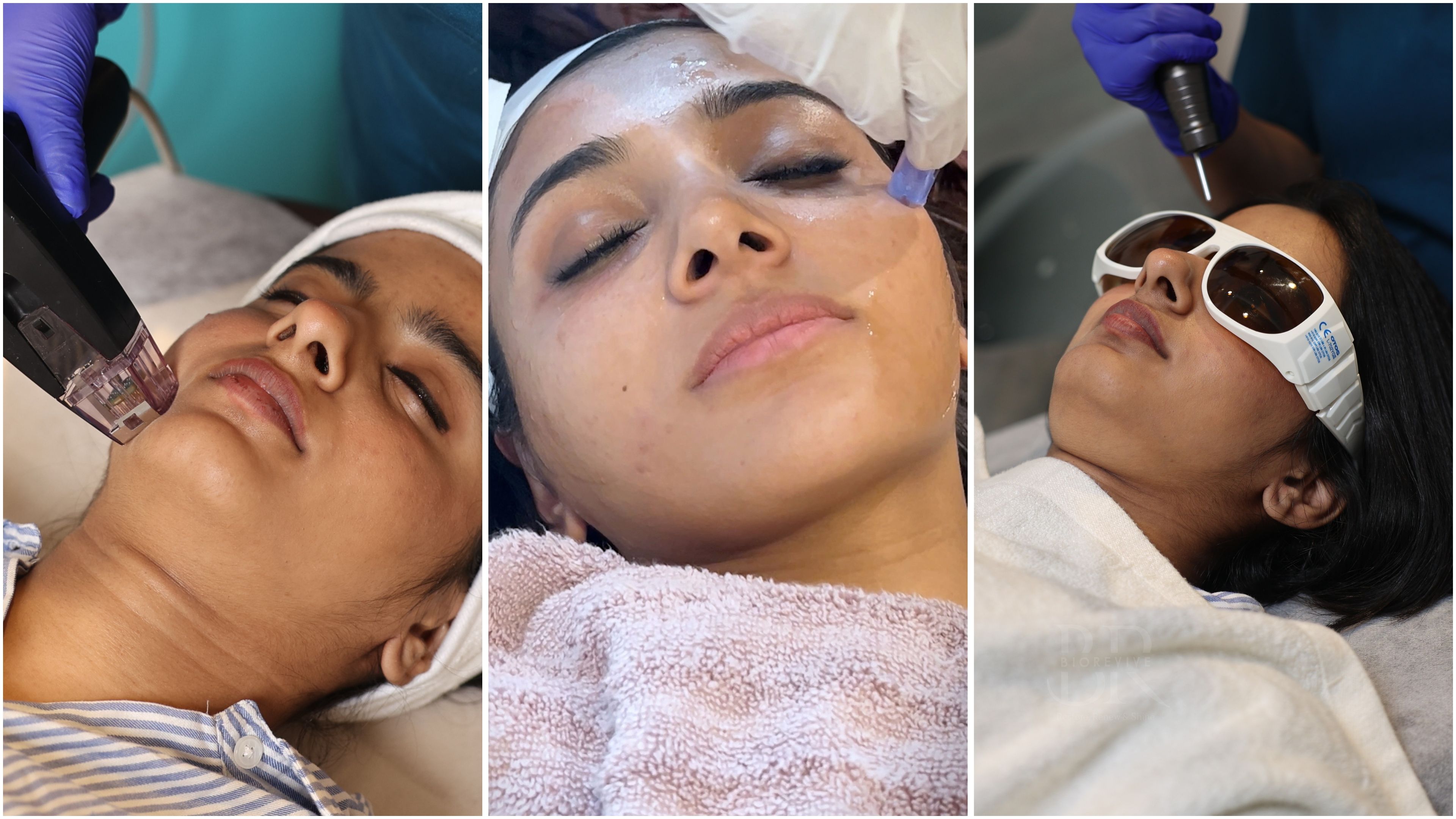
Different procedures target different aspects of acne-related skin changes. At BioRevive, options such as Morpheus 8,Dermapen-4, DermaFrac, Hollywood Spectra, Cosmelan, Dermamelan, and Pumpkin Facial may be considered according to the individual's concerns and clinical assessment.

1. Morpheus8 for Texture and Collagen Remodelling

Morpheus8 combines microneedling with radiofrequency energy. Tiny needles create controlled micro-injuries while radiofrequency energy delivers heat into the deeper skin layers.

The goal is to stimulate the body's healing response and encourage collagen remodeling.

It may be considered for patients with concerns such as

  • Atrophic acne scars
  • Uneven skin texture
  • Enlarged-looking pores
  • Mild skin laxity
  • Overall textural irregularity

Research on fractional radiofrequency microneedling shows promising results. A 2025 systematic review evaluated 16 studies involving 481 patients and found fractional RF microneedling promising for acne-scar management, while also highlighting the need for further research to establish optimal treatment parameters.

Importantly, evidence for RF microneedling as a treatment category should not automatically be interpreted as proof that every specific device or protocol produces identical results.

2. Dermapen-4 for Collagen Induction

Dermapen-4 is a microneedling-based treatment that creates controlled microchannels in the skin.

These micro-injuries can trigger a wound-healing response and encourage collagen production, potentially improving the appearance of selected depressed scars and uneven texture over time.

Microneedling has been studied more extensively than many newer device-specific approaches. A systematic review found improvement in acne-scar appearance across the clinical literature it evaluated, although comparisons with other treatments were not always consistent.

A separate systematic review of randomized controlled trials also found that microneedling can be an effective option for atrophic acne scars, while noting the need for larger and longer studies.

Because collagen remodeling takes time, patients may require a series of treatments rather than expecting a major change after one session.

3. Dermafrac for Mild Texture and Skin Rejuvenation

DermaFrac combines microneedling with topical serum infusion and may be considered when acne-related concerns are accompanied by mild textural irregularities, dullness, or dehydration.
It can be positioned as a skin rejuvenation treatment rather than a replacement for procedures specifically designed to address deeper structural scars.
It may be considered for:
  • Mild textural irregularities
  • Dull-looking skin
  • Uneven appearance
  • Mild post-acne concerns
  • Dehydrated skin
Deeper ice-pick or sharply defined scars may require a different treatment strategy.

4. Hollywood Spectra for Post-Acne Pigmentation

Not every person who describes their skin as having “acne scars” has a depressed scar.

Sometimes the primary concern is brown pigmentation or uneven skin tone after acne has healed.

Hollywood Spectra may be considered when pigmentation and overall skin tone are the main concerns. Laser-based treatments can be useful for selected pigmentation problems, but the appropriate wavelength, settings, and treatment plan depend on the condition being treated and the individual's skin characteristics.

For Indian skin tones, careful treatment planning is important because inflammation can sometimes contribute to post-inflammatory pigmentation.

A consultation can therefore help determine whether the main concern is

Texture → collagen-remodelling approach

Pigmentation → pigment-focused approach

Both → appropriately planned combination treatment

Can Pigmentation Treatments Help After Acne?

Yes, but pigmentation management should be distinguished from structural scar correction.

Cosmelan

Cosmelan is primarily used as a pigmentation-management approach and may be considered when dark post-acne marks are a major concern.

It is more relevant to uneven pigmentation than to deep depressed scars.

Dermamelan

Dermamelan is another pigmentation-focused treatment that may be considered for persistent hyperpigmentation.
The suitability of pigmentation treatments depends on factors such as skin sensitivity, pigmentation pattern, previous treatments, and current skincare.

Pumpkin Facial

A Pumpkin Facial can provide a gentler approach to surface renewal, dullness, and overall radiance.
It may be useful as a maintenance or supportive treatment for selected patients, but it should not be presented as a procedure that corrects deep atrophic acne scars.
In simple terms, improving skin brightness is not the same as restructuring a depressed scar.

Which Treatment May Suit Different Acne-Related Concerns?

Treatment Main Focus May Be Considered For
Morpheus8 RF microneedling and collagen remodelling Atrophic scars and uneven texture
Dermapen-4 Microneedling and collagen induction Selected depressed scars and texture
DermaFrac Needling and serum infusion Mild texture and skin rejuvenation
Hollywood Spectra Laser-based pigment management Selected post-acne pigmentation
Cosmelan Pigmentation management Dark post-acne marks
Dermamelan Pigmentation management Persistent pigmentation concerns
Pumpkin Facial Surface renewal and radiance Dullness and maintenance

Treatment selection, session frequency, and downtime vary from person to person and should be determined after a professional assessment.

How Do You Choose the Right Acne Scar Treatment in Chennai?

Choosing a procedure based only on social media photographs, price, or the latest treatment trend can be misleading.
A proper consultation should establish:

1. What type of scar do you have?

Rolling, boxcar, and ice-pick scars can respond differently to treatment.

2. Is the concern actually a scar?

Dark marks and redness may require a pigmentation-focused approach rather than aggressive scar resurfacing.

3. Is active acne still present?

Ongoing inflammatory acne may need to be treated before intensive scar procedures.

4. What is your skin tone and pigmentation history?

Treatment settings need to be selected carefully, particularly for people who are prone to post-inflammatory pigmentation.

5. What downtime fits your routine?

Some procedures may cause temporary redness, swelling, peeling, or sensitivity, while others may involve relatively little downtime.

6. What result are you expecting?

The realistic goal is usually improvement rather than completely scar-free skin.
The AAD notes that different acne scars can require different treatments and that dermatologists may use more than one approach when appropriate.
During a consultation, an appropriately qualified medical professional can assess the scar type, depth, pigmentation, current acne activity, skin sensitivity, previous procedures, medications, and treatment goals. This information helps determine whether a single procedure or a staged treatment plan is more appropriate. 

How Many Sessions Are Usually Needed?

There is no universal number of sessions.
Treatment frequency depends on:
  • Scar depth
  • Treatment selected
  • Area being treated
  • Skin response
  • Pigmentation risk
  • Previous procedures
  • Healing time
Collagen-induction procedures such as microneedling and RF microneedling generally produce gradual changes rather than instant scar removal.
The treatment plan should therefore allow sufficient time between procedures for the skin to recover and remodel.
More aggressive treatment is not automatically better.

What Results Can You Expect?

The goal of acne-scar treatment is generally to reduce the visibility of scars and improve overall skin texture, rather than guarantee complete scar removal.

Depending on the treatment selected and your individual response, you may notice:

  • Smoother-looking skin
  • More even skin texture
  • Reduced visibility of some depressed scars
  • Improved overall skin tone
  • Reduced appearance of post-acne pigmentation
  • Better overall skin quality

Results develop at different rates. Treatments such as microneedling and RF microneedling work partly through collagen remodeling,, so improvements may continue to develop after the initial recovery period.

The extent of improvement depends on factors such as scar type, scar depth, skin characteristics, the treatment selected, and the number of sessions required. Before-and-after photographs can help demonstrate possible improvements, but they should not be considered a guarantee of a specific outcome.

What Is the Recovery Like?

Recovery depends on the procedure, treatment intensity, and individual skin response.

After Morpheus8

Temporary redness, swelling, sensitivity, or small marks may occur. Recovery varies according to treatment settings.

After Dermapen-4

Mild redness, warmth, or sensitivity may occur immediately after treatment and generally settles as the skin recovers.

After DermaFrac

Temporary redness or sensitivity can occur, although downtime may be limited.

After Hollywood Spectra

Downtime depends on the indication and laser settings. Some treatments may involve little visible downtime.

After Cosmelan or Dermamelan

Dryness, peeling, redness, or sensitivity may occur depending on the protocol and individual response.

After a Pumpkin Facial

Recovery is generally milder than with intensive resurfacing procedures, although sensitivity can vary according to the formulation used.
Your practitioner should provide specific post-treatment instructions based on the procedure you have undergone.

How Should You Care for Your Skin After Treatment?

Post-treatment care is an important part of the overall plan.

Use Sun Protection

UV exposure can worsen pigmentation. Follow your clinician's advice regarding broad-spectrum sunscreen and sun avoidance.

Keep Skincare Gentle

Immediately after some procedures, your skin may be more sensitive. A gentle cleanser and suitable moisturizer may be recommended.

Do Not Pick or Scratch

If peeling, flaking, or crusting occurs, allow the skin to heal naturally unless your practitioner gives different instructions.

Follow Product Instructions

Retinoids, exfoliating acids, and other active ingredients may need to be temporarily paused depending on the procedure.

Avoid Unplanned Procedures

Do not combine professional treatments or strong exfoliating products without discussing them with your dermatologist.

Can Different Acne Scar Treatments Be Combined?

Sometimes. Combination treatment may be considered when a patient has more than one concern, such as depressed scars together with post-acne pigmentation.

For example, a collagen-remodelling procedure may be paired with an appropriate pigmentation-management approach. However, multiple procedures should not automatically be performed together. Their sequence, intensity, and spacing should be planned according to skin recovery and pigmentation risk.

Why Does Acne Scar Treatment Require Careful Planning for Chennai Patients?

Many acne-scar procedures can be performed on Indian skin, but treatment settings and procedure selection require careful consideration. Skin that is more prone to post-inflammatory hyperpigmentation may react differently to lasers, microneedling, radiofrequency, and other resurfacing procedures.

For patients in Chennai, regular sun exposure can also make pigmentation management an important part of treatment planning. Appropriate sun protection, conservative treatment settings when required, and professional supervision can help reduce avoidable complications.

Your practitioner may consider your skin tone, history of pigmentation, current inflammation, previous reactions to procedures, recent sun exposure, and the specific technology being used.

Who Is a Good Candidate?

Treatment may be considered for people with:
  • Depressed acne scars
  • Uneven skin texture
  • Enlarged-looking pores
  • Post-acne pigmentation
  • Persistent marks after acne
  • Mild textural irregularities

However, active infection, significant inflammation, open wounds, severe irritation, recent aggressive procedures, or certain medical conditions may require treatment to be postponed.

Tell your dermatologist or practitioner about any prescription medications, active skin conditions, and previous reactions before treatment so they can determine whether the procedure is appropriate and whether any precautions are needed. 

How Much Does Acne Scar Treatment Cost in Chennai?

The cost can vary considerably because there is no single treatment plan for every patient.

Factors may include:

  • Procedure selected
  • Treatment area
  • Number of sessions
  • Scar severity
  • Technology used
  • Combination treatments
  • Individual treatment plan

Instead of choosing a procedure based only on price, consider the quality of the consultation, practitioner expertise, treatment suitability and safety protocols.

At BioRevive, treatment cost is determined after assessment because the procedure selected, treatment area and number of sessions can vary significantly between patients. If an approved current price range is available, it can be added here rather than publishing a generic estimate that may not reflect your actual treatment plan. 

Why Choose BioRevive for Acne Scar Care?

At BioRevive, acne-scar concerns are assessed based on scar type, skin tone, pigmentation, active acne, and individual treatment goals.

Depending on the assessment, your practitioner may recommend a single procedure or a staged combination approach using options such as Morpheus8, Dermapen-4, DermaFrac, or Hollywood Spectra, while pigmentation-focused treatments such as Cosmelan and Dermamelan may be considered when post-acne pigmentation is the primary concern.

A pumpkin facial may also be considered when a gentler skin-renewal or maintenance treatment is appropriate.

The aim is to create a treatment plan based on the condition of your skin rather than applying the same procedure to every patient.

Related Skin Treatments

Depending on your overall skin concerns, other treatments may also be considered as part of a broader skin-maintenance plan:
HydraFacial
MesoJet
O2 Derma
Pollogen
Forma
Not all of these treatments are suitable for every acne scar. Their role depends on the specific concern being addressed.

Frequently Asked Questions

Can acne scars disappear completely?

Usually, treatment aims to make scars less noticeable rather than guarantee complete removal. The degree of improvement depends on scar type, depth, skin characteristics, and individual response.

Which treatment is best for deep acne scars?

There is no single best procedure for every deep scar. Selected atrophic scars may benefit from collagen-remodelling procedures, while certain tethered or deep scars may require techniques such as subcision or other dermatologist-directed procedures.

Is microneedling effective for acne scars?

Microneedling has clinical evidence supporting its use for selected acne scars. Systematic reviews have reported improvement in acne-scar appearance, although outcomes vary and further research is needed to compare different treatment approaches.

Can pigmentation and acne scars be treated together?

In selected patients, yes. However, pigmentation and structural scarring are different concerns and should be assessed separately before planning treatment.

How long does it take to see results?

Some changes may become visible after the initial healing period, but collagen-remodelling procedures generally require time for progressive improvement. A series of treatments may be recommended.

Can I have treatment if I still have active acne?

Active inflammatory acne should generally be controlled before intensive scar treatment. Continuing to develop inflammatory lesions can contribute to new scarring.

Are acne-scar treatments painful?

Comfort varies according to the procedure and individual sensitivity. Appropriate numbing or comfort measures may be used for procedures such as microneedling or RF microneedling.

Will acne scars come back after treatment?

A treated scar does not typically return in the same way as active acne. However, new inflammatory acne can create new scars, which is why long-term acne control remains important.

Medical Evidence and Research

Research into acne-scar treatment continues to evolve, particularly in areas such as microneedling, radiofrequency microneedling, laser treatments, chemical peels, and combination approaches.
The American Academy of Dermatology (AAD) recognizes several approaches for depressed acne scars, including microneedling, radiofrequency microneedling, laser treatment, chemical peels, and selected surgical procedures. The AAD also emphasizes that treatment selection depends on the individual's scar characteristics and clinical situation.
A 2020 systematic review of microneedling for acne scarring found improvement in scar appearance across the studies reviewed, although the evidence was not uniform when different treatment approaches were compared.
A 2022 systematic review and meta-analysis of randomized controlled trials also evaluated microneedling for acne scars and reported evidence supporting its use while highlighting the need for additional research.
A 2025 systematic review of fractional radiofrequency microneedling evaluated 16 studies involving 481 patients and found the treatment promising for acne scarring, while noting that additional randomized research is needed to establish optimal treatment parameters.
These findings support the use of established treatment categories, but evidence for a particular treatment category should not automatically be presented as evidence that every branded device or proprietary protocol will produce the same results.

What does this mean for patients?
  • Results should not be guaranteed.
  • Treatment should be individualised.
  • Scar type and skin characteristics should be assessed before treatment.
  • Active acne should be addressed where clinically appropriate.
  • Combination treatments should be used selectively.
  • Device-specific claims should be supported by evidence relating to that particular technology where available.
  • Treatment should be performed by an appropriately trained and qualified medical professional, with appropriate clinical supervision where required. 

References

1. American Academy of Dermatology (AAD) — Acne Scars: Diagnosis and Treatment

Provides guidance on acne-scar assessment and treatment options including microneedling, radiofrequency microneedling, lasers, chemical peels and other procedures.
American Academy of Dermatology — Acne Scars: Diagnosis and Treatment

2. DermNet — Acne Scarring

Provides clinical information on acne-scar types, causes and management approaches.
DermNet — Acne Scarring

3. Mujahid et al. — Microneedling as a Treatment for Acne Scarring: A Systematic Review

Dermatologic Surgery, 2020.
PubMed — Microneedling as a Treatment for Acne Scarring

4. Shen et al. — Microneedling Monotherapy for Acne Scar: Systematic Review and Meta-Analysis of Randomized Controlled Trials

Aesthetic Plastic Surgery, 2022.
PubMed — Microneedling Monotherapy for Acne Scar

5. Fractional Radiofrequency Microneedling for Acne Scars — Systematic Review of Current Evidence

2025 systematic review evaluating fractional RF microneedling for acne-scar management.
PubMed — Fractional Radiofrequency Microneedling for Acne Scars

Conclusion

Acne may eventually disappear, but the scars and marks it leaves behind can remain much longer.

The most appropriate treatment is not necessarily the newest or strongest procedure. It is the approach that matches your scar type, skin tone, pigmentation pattern, current acne status, and individual goals.

If you are considering Acne Scar Treatment in Chennai, a professional consultation can help determine whether your primary concern requires collagen remodeling, pigmentation management, resurfacing, scar-specific procedures, or a carefully planned combination.

At BioRevive, the focus is on creating a personalized treatment pathway designed around your skin rather than applying the same procedure to every patient.

Book a consultation with BioRevive to understand your acne scars, explore suitable treatment options, and develop a personalized plan for clearer, smoother-looking skin.

Read More

Pigmentation vs Melasma

September 15, 2026
Read More

Acne Scar Treatment

September 7, 2026
Read More